Pedals 2026-09-21
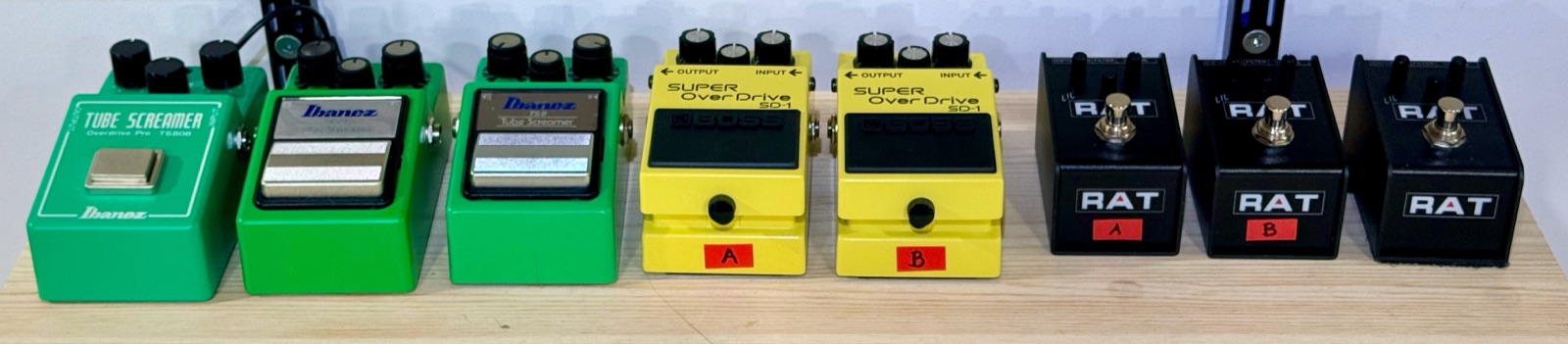
| What it is | Eight overdrive and distortion pedals, each measured as bought or borrowed: six new units purchased in August 2026 and two used units on loan. Three models are present in more than one unit. Each pedal's notes, which travel with the download, state its provenance and supply. |
|---|---|
| The pedals | As named in the library: Ibanez TUBE SCREAMER TS808 · single unit · 2026-09-21, Ibanez TUBE SCREAMER TS9 · unit A · 2026-09-21, Ibanez TUBE SCREAMER TS9 · unit B · 2026-09-21, BOSS SUPER Over Drive SD-1 · unit A · 2026-09-21, BOSS SUPER Over Drive SD-1 · unit B · 2026-09-21, LiL' Rat · unit A · 2026-09-21, LiL' Rat · unit B · 2026-09-21, LiL' Rat · unit C · 2026-09-21. The maker is part of the name; PedalScope's Maker field is empty. |
| Captured | 2026-09-21, one session, one calibration, under the project's publishable-set checklist. |
| What it holds | 150 records across eight pedals. Each pedal was measured in three settings — its drive control at min, noon and max, every other control at noon — with a full fingerprint of six measurement kinds per setting (Harmonic Distortion, Transfer Curve, Compression, Gain Map, Chord IMD, Waveform Matrix): 24 settings, 144 records. The remaining six are one repeat of LiL' Rat unit A's noon setting at the end of the session, re-patched and re-set by eye. Harmonic Distortion at 8 averages; Waveform Matrix 7 × 7 (E2–E6, seven levels); a control-state photo on every setting. |
| The rig, in one line | RME Babyface Pro at 96 kHz, instrument input (1 MΩ), through the project's breakout box; drive calibrated in volts at the box's input (0 dBFS = 4.828 V pk, so the standard −26 dBFS drive is 242 mV pk); source impedance 0 Ω; one 9 V supply for every pedal; one loopback calibration, 2026-09-21 13:15:20, embedded byte-for-byte in every record (latency 1169 samples, flatness +0.10 / −0.63 dB, floor 0.012 %). |
| Download | PedalScope-Pedals-2026-09-21.zip — 283 MB zipped (604 MB unpacked), one folder holding the eight .pedalscope packages, one per pedal. Hosted as a release asset of the public repository PhaseDog/pedalscope-open-source, with the full-size photographs beside it. |
| SHA-256 | 9896b681519343e36cb2d311b7f5730a207f8af106a8f97abcf7d6833ad9671c — to check the download, run shasum -a 256 on the zip and compare. |
| Licence | CC BY 4.0 — use it, share it, build on it, with attribution to PedalScope. The PedalScope name and mark are not part of the grant. |
To open it: unzip, then in PedalScope choose
File ▸ Import Measurements… and select all eight
.pedalscope files in the folder. (Double-clicking opens one
package at a time; opening several at once from Finder currently imports
only the first.) Each pedal arrives as its own pedal in your library, and one
report lists all eight. Opening the set a second time changes
nothing.
What the records carry — and what they don't hide
Every record ships exactly as it was measured, with its own calibration, its measurement floors, and its bounds wording. No record was re-taken because a nicer one was wanted. What a reader should know in advance:
- 14 of the 24 Chord IMD records carry a coherence notice. Their check reads over the bar, and each was captured as it read — no setting was re-taken or changed. The app states on each such record that its floor and product levels are not trustworthy; the page says so here rather than leaving it for you to find. The other kinds of the same settings are unaffected.
- LiL' Rat unit C's 18 records carry no room temperature. The field was empty when its run started and cannot be entered after capture; every other record carries one.
- 54 records keep their capture-time titles. Two
pedals were renamed after they were measured — LiL' Rat units A and B
from
Lil' Ratto the unit's own casing, and TS9 unit B, whose records were titledunit Awhen captured. PedalScope displays every record under the pedal's current name; the stored titles, which you will see if you read the package's files, are left as they were written. - The bracketing null runs are not in the set — a bare-loop capture was taken before and after the pedals, and their floors are stated here instead: fundamental gain 0.000 dB on both; Chord IMD capture floor −137.8 and −137.2 dBc, coherence 23.0 and 24.8 dB under the bar; Gain Map peak 0.058 % and 0.025 %. The set sits between two clean floors.
The per-setting control-state photos and notes were attached to each setting's Harmonic Distortion record after its run, from photos taken at the bench during the session; the photo shows on every record of the setting.
About averaging. This set's Harmonic Distortion records were averaged over eight sweeps; PedalScope's default is four. Compare a record you measure at the default against one of these and Compare shows its cross-averaging note — neutral wording, and the distance is still computed. That is the instrument stating that the two sides have different resolution limits, not a fault on either side.
A published set is permanent: a later capture of any of these pedals is published under its own dated name and arrives as a separate pedal, so the two compare cleanly instead of interleaving.